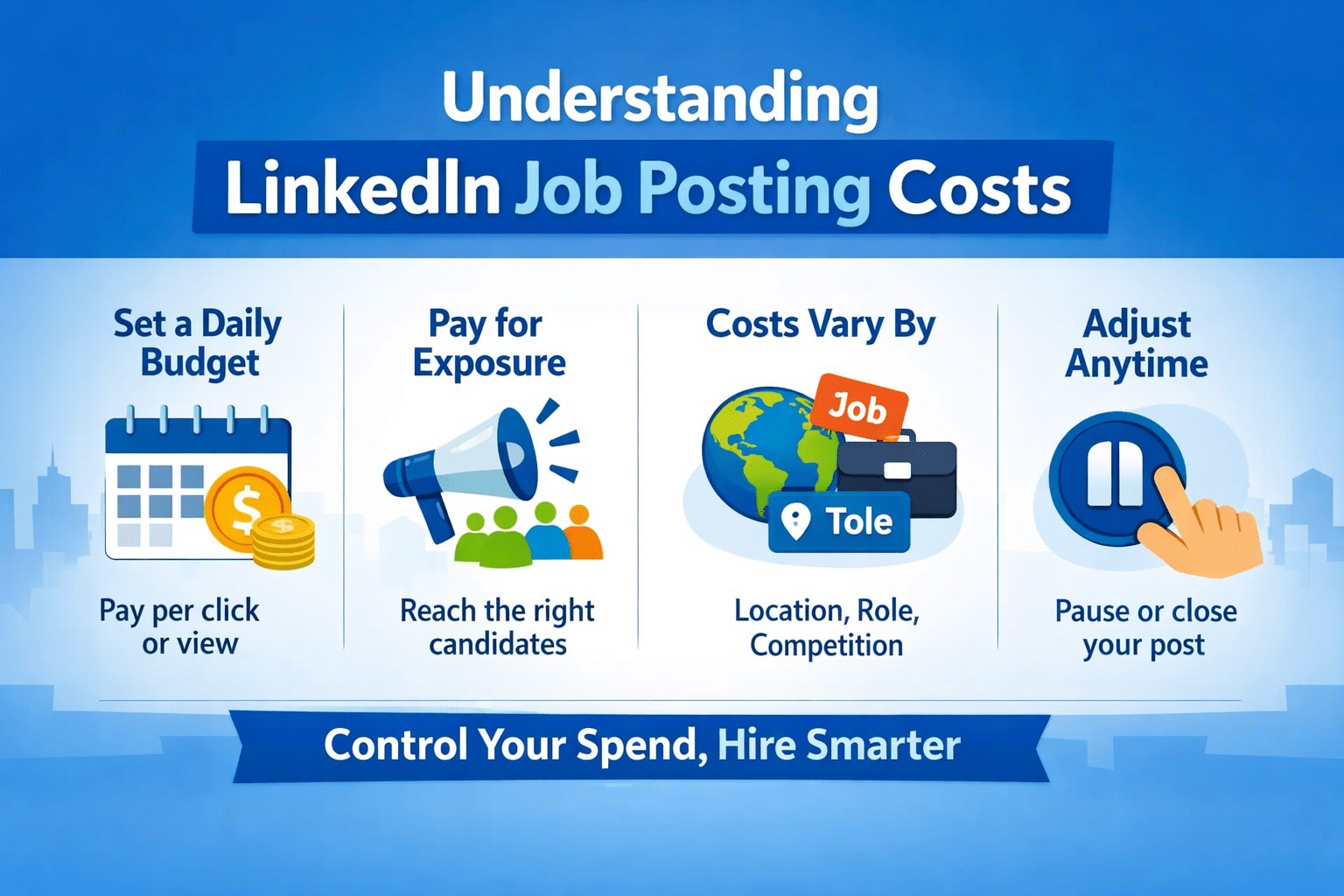
LinkedIn job posting cost, If you’ve ever tried to post a job on LinkedIn and felt a little lost when it came to pricing, you’re not alone. LinkedIn doesn’t show a simple flat fee on the screen and say, “Pay this amount for 30 days.” Instead, it leans on a flexible, ad-style pricing model that can look confusing if you’re used to old-school job boards with one-time posting charges.
The good news? Once you understand how LinkedIn job posting cost actually works, you can control your spend, avoid surprises, and get better results without throwing money out the window. In this guide, we’ll walk through how pricing works, what affects your cost, and how to make the most of your budget in a straightforward, conversational way.
Because I don’t have live access to LinkedIn’s current internal pricing screens, treat this as a strategic guide, not a precise rate card; specifics can change over time and by region.
What Makes LinkedIn Different From Traditional Job Boards
Traditional job boards usually follow a simple model: you pay a fixed fee per job posting for a fixed time period (like 30 days), and that’s it. LinkedIn, however, blends job posting with advertising-style mechanics.
Instead of just paying for “a listing,” you essentially pay for exposure:
-
You pay for how many people see your job.
-
You can influence that by setting a daily budget.
-
Your job can behave more like an ad that’s pushed into relevant feeds, not just a static listing.
This is why two companies posting similar roles can pay very different totals by the time the job closes. It depends on their region, role, budget, competition, and how long they leave the job active.
LinkedIn Pay-Per-Click Style Model: The Basics
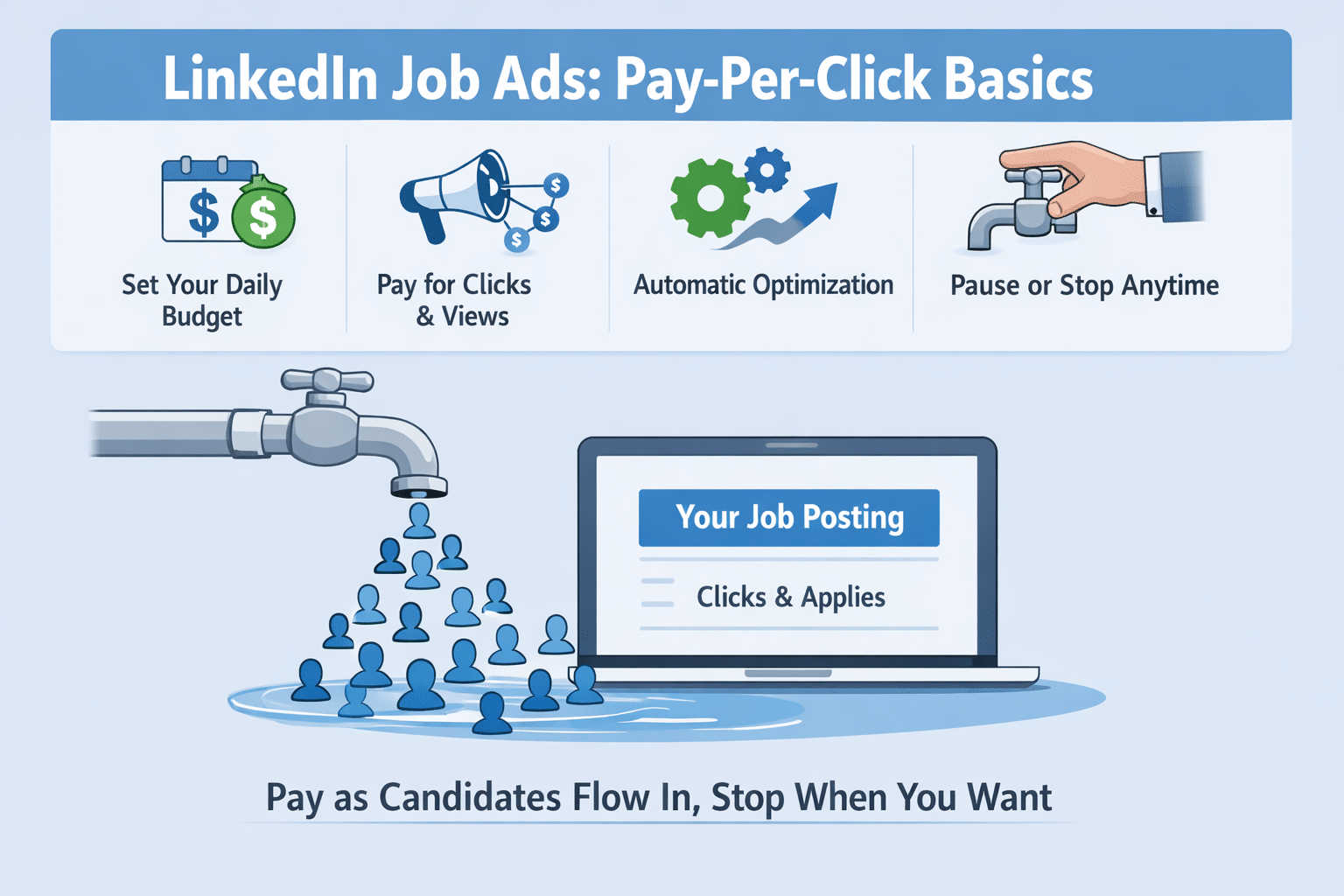
LinkedIn often uses a model that closely resembles pay-per-click advertising for jobs. Instead of a fixed “post once, pay once” structure, it commonly works like this in practice:
-
You set a daily budget for your job posting.
-
LinkedIn distributes your job to relevant candidates and charges you for clicks or interactions within that budget.
-
The system optimizes delivery automatically, similar to how ad platforms do.
-
You can pause or close the job at any time to stop spending.
Think of it like putting your job ad on a daily “tap”: turn the tap open, candidates flow in and you pay as they come; close it, and the flow (and cost) stops.
Exact daily minimums and rates can vary by country, currency, and time, so it’s always smart to check directly in your LinkedIn Recruiter or Jobs interface when you’re setting up the role.
Key Factors That Affect Your LinkedIn Job Posting Cost
LinkedIn doesn’t charge every recruiter the same price, even for similar roles. Several factors influence what you ultimately pay:
-
Job Location
-
Roles in major, competitive markets (big cities, high-income countries) tend to cost more to promote because more employers are competing for the same talent.
-
Local roles in smaller or less competitive regions can sometimes be cheaper to promote.
-
-
Job Title And Seniority
-
In-demand roles like software engineers, data scientists, senior executives, or niche specialists often attract higher cost per click or higher budget needs.
-
Junior or generalist roles may cost less to promote, but also attract more volume (and sometimes more irrelevant clicks).
-
-
Industry And Competition
-
If many companies in your industry are actively hiring for the same skill set, you’re competing in an auction-like environment.
-
More competitors bidding for attention usually means higher cost for visibility.
-
-
Your Daily Budget And Bid Level
-
LinkedIn may suggest a range for your daily budget. If you pick the lower end, you might get slower results or fewer impressions.
-
If you pick a higher budget, LinkedIn has more room to show your job to more people, faster.
-
-
Job Ad Quality And Relevance
-
Clear, well-written job descriptions that match real candidate profiles tend to perform better.
-
Higher engagement and relevance can lead to more efficient spend, because LinkedIn’s algorithm prefers ads that get good responses.
-
-
Duration Of The Posting
-
The longer the job remains active, the more days your daily budget is spent, so the total cost climbs.
-
That’s why it’s important to pause or close the job once you’ve got enough strong candidates.
-
So instead of thinking “How much does a LinkedIn job posting cost?” as a fixed number, it’s smarter to think: “What am I willing to spend per day, and for how long, to fill this role?”
Daily Budget vs Total Spend: How To Plan Your Costs
Because the system is budget-based, your total cost is basically:
Daily budget × Number of days the job is active (with spend)
For example:
-
If you set a modest daily budget and leave the job active for 30 days, your total spend is that daily amount times 30.
-
If you hire faster and close the job in 10 days, you stop spending after day 10.
This gives you flexibility:
-
If a role is urgent and high-value, you might choose a higher daily budget to get more visibility quickly.
-
If it’s a non-urgent, ongoing hiring need, you might choose a moderate budget and let it run longer.
The key point: you control both the “speed” (daily budget) and the “distance” (duration).
When LinkedIn Suggests A Budget: What To Do
When you create a job post, LinkedIn often suggests a recommended daily budget based on:
-
Your job title.
-
Your location.
-
Historical performance and competition.
You don’t have to blindly accept that number. Treat it as:
-
A hint at what other advertisers might be spending for similar roles.
-
A starting reference point you can move up or down.
If you’re unsure:
-
Start near the lower end of the suggested range.
-
Watch the number of applicants and the relevance for a few days.
-
If you’re not getting enough qualified candidates, gradually increase the budget.
-
If you’re getting too many low-quality applicants, refine your job description and target, and possibly reduce spend while you adjust.
How Sponsored Jobs Differ From Basic Job Posts
Many people don’t realize there’s a difference between a simple job posting and a more aggressively promoted “sponsored” job on LinkedIn.
In practice, here’s how they usually differ conceptually:
-
Basic job posts
-
Appear in search results and on your company page.
-
Rely more on organic discovery and job seeker searches.
-
May have limited reach compared to sponsored jobs.
-
-
Sponsored jobs
-
Are actively pushed into candidate feeds and search results more often.
-
Often use that budget/bid model to win impressions.
-
Can dramatically increase visibility, especially in competitive markets.
-
The cost difference is that sponsored jobs will typically consume a daily budget and can cost more in total, but they can also fill roles faster and reach talent that might not be actively searching.
If you’re hiring for a critical position, the extra spend on a sponsored job can be worth it. For lower-priority roles, basic postings and organic reach may be enough.
How LinkedIn Compares To Other Job Boards In Cost Terms
While exact numbers vary by market and time, the pattern is usually:
-
LinkedIn
-
Often more expensive per click or per applicant than mass job boards.
-
Stronger for professional, white-collar, and mid-to-senior roles.
-
Has richer candidate data (profiles, experience, recommendations).
-
-
Traditional job boards
-
Typically cheaper per posting, with flat, predictable fees.
-
May generate more volume but lower overall quality, depending on the role.
-
Less granular targeting in many cases.
-
-
Niche job boards
-
Sometimes similar or slightly lower cost than LinkedIn for very specific roles.
-
Smaller audience but highly relevant candidates.
-
So, if you’re hiring for specialized or professional roles where quality matters more than raw volume, the higher cost of LinkedIn can make sense. If you’re hiring hourly staff or high-volume positions, other platforms might be more cost-effective.
How To Reduce Your LinkedIn Job Posting Cost Without Killing Results
You might not be able to control LinkedIn’s base auction environment, but you can control how efficiently you spend. Here are practical ways to keep costs sane:
-
Write A Clear, Specific Job Title
-
Avoid vague or overly creative titles that confuse the algorithm and candidates.
-
Use the titles people actually search for (e.g., “Digital Marketing Manager” instead of “Growth Wizard”).
-
-
Nail The Job Description
-
Make it detailed, honest, and candidate-focused.
-
Include responsibilities, required skills, nice-to-have skills, benefits, and growth opportunities.
-
Clarity improves relevance, which improves performance.
-
-
Use Filters And Targeting Wisely
-
Narrow your targeting by location, experience level, and relevant criteria.
-
Don’t go so broad that you waste clicks on people who clearly don’t fit.
-
-
Optimize Your Application Flow
-
If candidates hit a messy, long application form, they drop off.
-
Use a simple, streamlined application process, especially on mobile.
-
-
Pause Or Close Jobs Promptly
-
Once you have a strong pool of candidates or have made a hire, pause or close the job.
-
There’s no sense paying for more clicks when you don’t need them.
-
-
Track Candidate Quality, Not Just Quantity
-
Look at how many applicants make it to interview or offer stages.
-
If you get a lot of irrelevant applicants, it’s not a “cheap” campaign, even if the cost per click looks low.
-
Should Small Businesses Use LinkedIn Job Posts, Given The Cost?
If you’re a smaller business, you might look at LinkedIn’s cost structure and think it’s too expensive. But it depends entirely on the role and the value of a good hire.
Ask yourself:
-
How much is a wrong hire going to cost me in time, salary, and lost opportunity?
-
How valuable is the right person in this role over 12–24 months?
-
Is my ideal candidate a professional who’s likely active on LinkedIn?
For many small businesses hiring for key roles (like a marketing lead, senior developer, or operations manager), spending a few hundred dollars more on LinkedIn but getting a better shortlist is often a smart investment.
On the other hand, if you’re hiring for entry-level, high-volume, or very local roles, traditional job boards, referrals, and local networks may give better cost efficiency.
Common Mistakes That Make LinkedIn Job Posting More Expensive Than It Needs To Be
A lot of wasted money on LinkedIn hiring comes from avoidable mistakes like:
-
Using overly broad or generic job titles
This attracts clicks from people who aren’t a good match, eating your budget without producing usable candidates. -
Not setting or monitoring a daily budget
Leaving campaigns running without checking performance can lead to surprise bills. -
Failing to refine after a few days
If you’re getting irrelevant applicants, don’t just accept it; tweak the title, description, and targeting. -
Keeping old postings running after the position is effectively filled
If the job is “technically open” but you already have finalists, turn off the spend. -
Relying only on LinkedIn and ignoring other sources
Using multiple channels and comparing cost-per-hire across them can help you keep LinkedIn spending in perspective.
Practical Strategy: How To Approach Your First LinkedIn Job Posting Budget
If you’ve never posted a job on LinkedIn before, here’s a simple, low-stress way to start:
-
Define The Role And Candidate Profile Clearly
-
Be very specific about experience, skills, location, and seniority.
-
-
Start With A Moderate Daily Budget
-
Choose something you’re comfortable spending for at least 7–10 days to see patterns.
-
-
Monitor Daily For The First Week
-
Watch the number of applicants, their relevance, and how many reach screening or interview stage.
-
-
Adjust Based On Reality
-
If you’re getting great candidates quickly, you can keep or even lower the budget and still fill the role.
-
If you’re not getting enough quality, tweak your title, description, or budget before deciding LinkedIn “doesn’t work.”
-
-
Compare Cost-Per-Hire Across Channels
-
If LinkedIn gives you better hires even at a higher cost-per-click, it may still be your most profitable channel in the long run.
-
Conclusion
When it comes to LinkedIn job posting cost, there’s no single “correct” number that applies to everyone. The platform uses a flexible, budget-based model that allows you to pay more for faster, wider reach or less for slower, more controlled visibility.
The real question isn’t, “How much does LinkedIn cost?” It’s, “What is a good hire worth to me, and how can I use LinkedIn smartly to find that person?”
If you understand the basics of how the pricing model works, set a reasonable budget, write a strong, targeted job post, and keep an eye on performance, you’ll be in a much better position than someone who just clicks “Next” and hopes for a miracle.