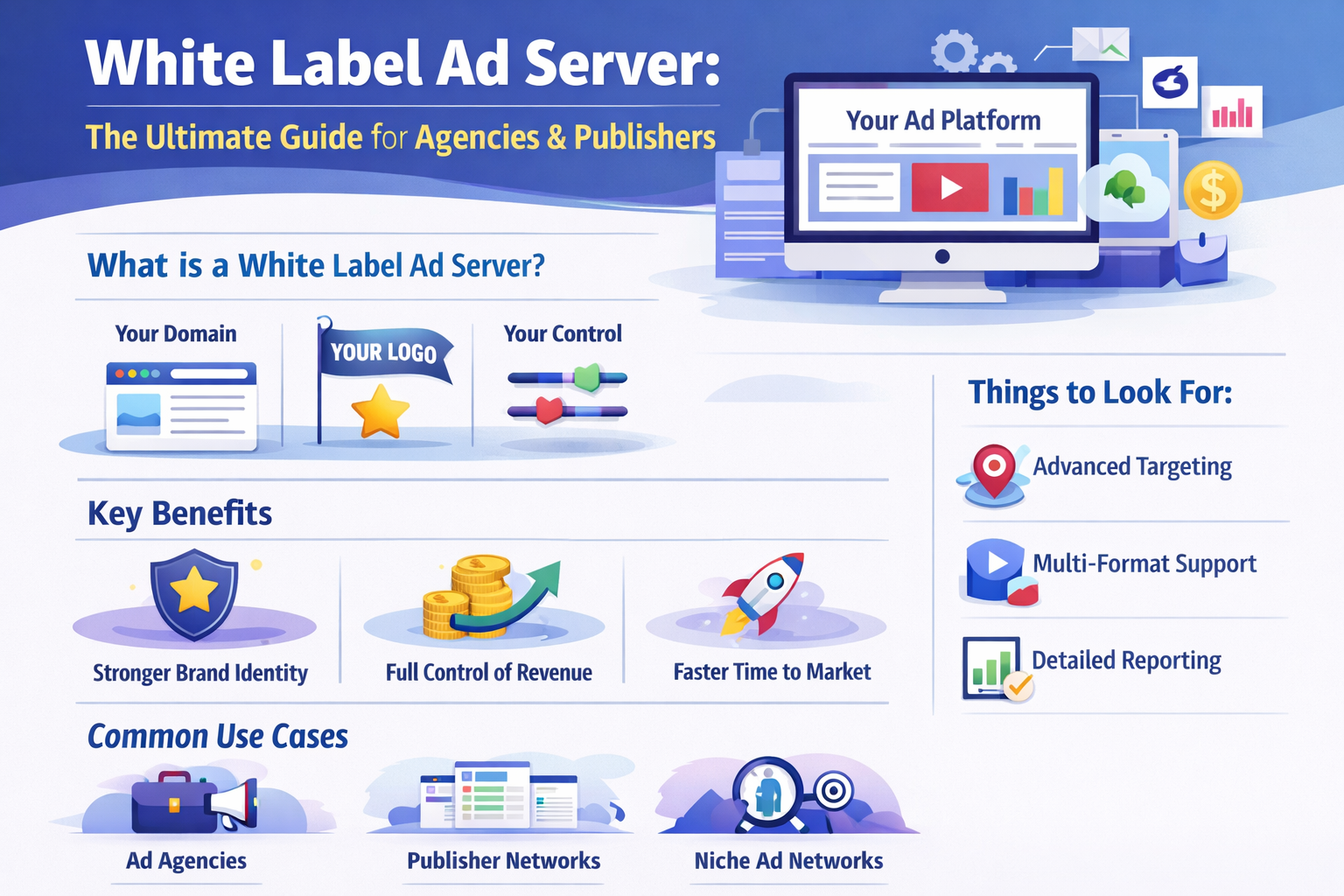
If you work in digital advertising, you already know how chaotic the landscape can feel. New formats keep appearing, privacy rules keep shifting, and platforms seem to change their rules overnight. In the middle of all this noise, one idea quietly gives agencies and publishers more control: the white label ad server.
Instead of pushing your campaigns through someone else’s brand and dashboards, a white label ad server lets you run your own ad platform under your own name. You keep the branding, you manage the data, and you decide how the revenue flows. Think of it as moving from tenant to landlord in the ad‑tech world—same building, but a very different level of control.
What Is A White Label Ad Server?
A white label ad server is a ready‑made ad‑serving platform that you can fully rebrand and operate as if it were your own product. Underneath, the engine is built and maintained by a specialist provider. On top, every visible touchpoint—domain, logo, colours, interface—belongs to you.
In practice, that means:
-
Clients and partners log in through your domain, not a third‑party URL.
-
Your logo and branding appear throughout the interface and reports.
-
You control which features are exposed and how your offer is packaged.
You can think of it like buying a powerful car chassis and engine, then designing the bodywork and interior to match your brand. The mechanics are handled, but the experience feels distinctly yours.
Why Not Just Build Your Own Ad Server?
On paper, building your own ad server sounds appealing. Who would not want a fully custom platform tailored to every quirk of their business? In reality, the cost, complexity, and risk put that option out of reach for most agencies and publishers.
To build an ad server from scratch, you would need:
-
Developers experienced in ad‑serving logic, caching, latency, and scaling.
-
Continuous updates to handle new formats, browser changes, and privacy rules.
-
Ongoing monitoring for fraud, performance issues, and security concerns.
It is like deciding to build your own plane from scratch instead of buying a ready‑to‑fly aircraft. Possible? Sure. Sensible for most businesses? Not really. A white label ad server gives you a tested aircraft with the option to customise the livery, cabin, and service model without reinventing aviation.
How A White Label Ad Server Works (Without The Jargon)
The underlying tech is sophisticated, but the flow is easier to understand when you zoom out. Here is the journey from page load to ad impression:
-
A user opens a website, app, or streaming channel where at least one ad slot is available.
-
That slot sends a request to the ad server: “An impression is available here, with these parameters.”
-
The ad server checks your rules: targeting, frequency caps, priorities, deals, and any external demand sources you have connected.
-
It picks the most suitable ad based on your logic—highest bid, fixed deal, audience match, pacing needs, or a mix.
-
The creative is delivered to the user, and the impression (plus any clicks or other events) is logged for reporting and billing.
When the ad server is white label, every touchpoint in that process that people see—the login, the interface, the reports—carries your brand, even though the underlying engine is licensed.
Who Uses White Label Ad Servers?
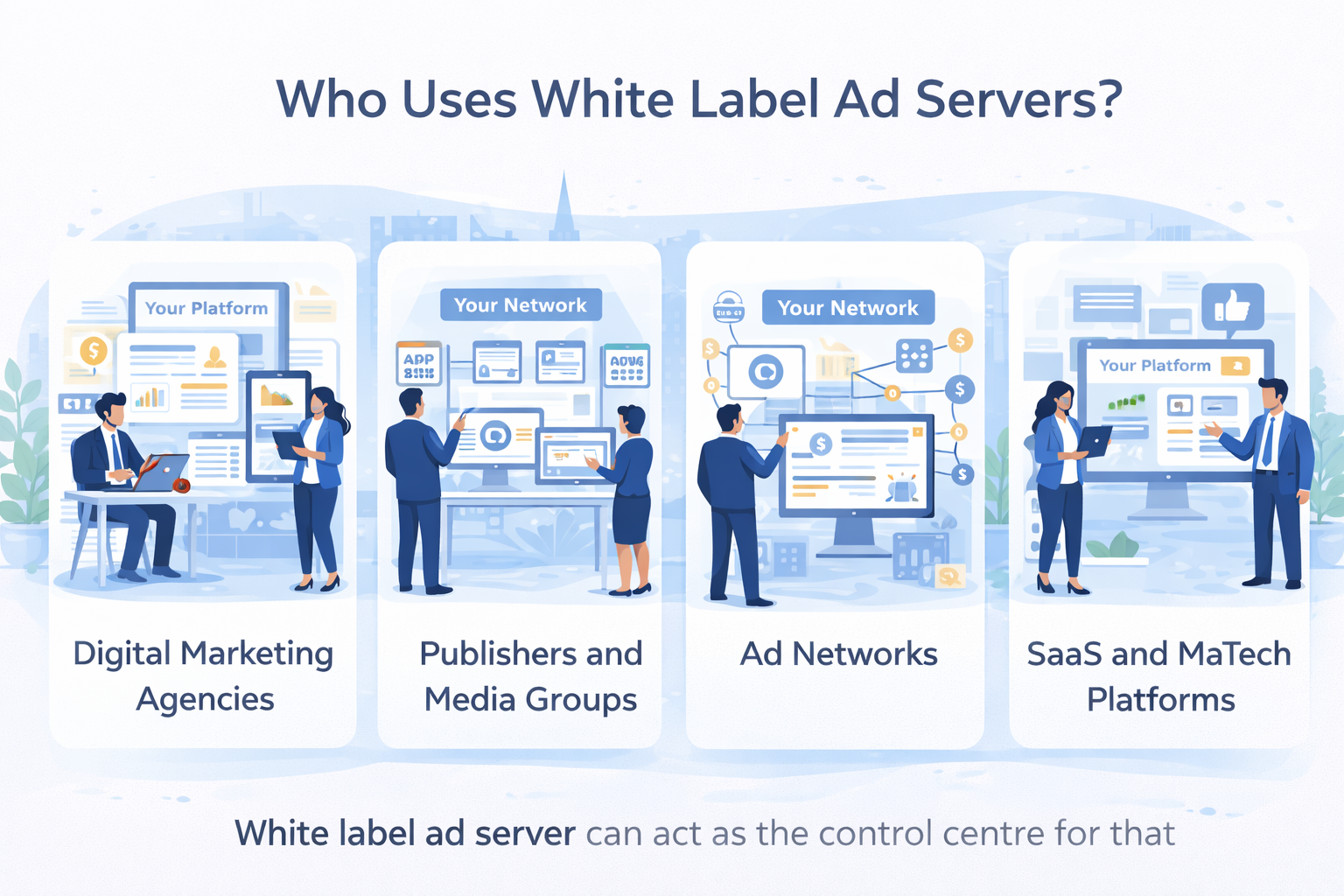
White label ad servers are not just for giant ad networks. They make sense for a range of players in the ecosystem:
-
Digital marketing agencies that want to present a proprietary platform rather than “we just log into someone else’s tool.”
-
Publishers and media groups that own multiple sites, apps, or CTV channels and want unified control over direct and programmatic demand.
-
Ad networks that aggregate inventory from many publishers and sell bundled audiences and placements to advertisers.
-
SaaS and MarTech platforms that want to add built‑in media buying or ad delivery capabilities under their own brand.
If ad revenue and campaign performance are central to your business, a white label ad server can act as the control centre for that entire operation.
Key Features To Look For In A White Label Ad Server
Not all platforms are created equal. The wrong choice can feel like buying a sports car with a lawnmower engine. When you evaluate options, pay attention to the following areas.
Branding And White Label Depth
Ask how far the branding goes:
-
Can you use your own domain for login and tracking?
-
Are emails, reports, and notifications branded as yours?
-
Can you customise colours, logos, and even certain UI elements?
The deeper the white label options, the more convincingly you can present the platform as “your own.”
Targeting And Campaign Controls
Look for flexible controls around:
-
Geo, device, OS, browser, time‑of‑day, and frequency caps.
-
Custom audiences or segments, if you manage your own data.
-
Pacing options, priorities, and budget controls for campaigns.
These levers are the dials your team will be turning every day. You want them to be powerful but intuitive.
Format Support
A modern ad server should handle:
-
Display (banner) formats.
-
Video (in‑stream and out‑stream).
-
Native units that blend into content.
-
In‑app and, ideally, CTV/OTT if you work with streaming.
If you plan to expand into audio or digital out‑of‑home, it is worth asking about those too.
Reporting, Analytics, And APIs
Detailed, reliable reporting is essential. Check:
-
How quickly stats update.
-
How granular the data is (per site, placement, creative, audience, etc.).
-
Whether there are APIs so you can pull data into your own dashboards or BI tools.
Good reporting is not just about pretty graphs; it is your instrument panel for optimising performance and proving value.
Multi‑Tenant And User Management
If you manage multiple advertisers, publishers, or teams, you need:
-
Role‑based access control (what each user can see and do).
-
Separate “accounts” or spaces so data is partitioned correctly.
-
Options to invite clients into their own portals under your brand.
This matters for both security and the quality of your client experience.
Core Benefits Of Using A White Label Ad Server
So, what do you actually gain beyond a shiny logo in the header? Quite a lot.
1. Stronger Brand Positioning
When clients log into a platform wearing your colours and domain, they see you as the provider, not just a user. That strengthens your positioning as a serious, tech‑enabled partner rather than “the agency that clicks buttons in someone else’s software.”
2. More Control Over Margins
With a white label model, you are not stuck with someone else’s fixed pricing tiers or revenue shares. You can decide how to structure fees and mark‑ups, design packages, or offer value‑added services around the core platform. That flexibility can make the difference between razor‑thin margins and a healthy profit.
3. Better Access To Data And Insights
Because you sit closer to the ad server itself, you typically have richer access to performance data. That can help you:
-
Diagnose issues faster.
-
Identify high‑performing segments.
-
Build more convincing reports and case studies.
Over time, those insights compound into better strategy and stickier client relationships.
4. Faster Time‑To‑Market For New Products
Want to launch a new ad network, a niche inventory package, or a managed service offering? A white label ad server lets you do that in weeks rather than the months or years it takes to design, build, and debug your own tech.
5. Scalability Without Rebuilding Everything
As you grow, you scale by adding clients, publishers, and campaigns—not by rebuilding your infrastructure every six months. The underlying platform is designed to scale; your job is to make smart use of it.
Common Use Cases: Where White Label Really Shines
To bring all this down to earth, here are some common scenarios where white label ad servers make a tangible difference.
Performance‑Driven Agency
You manage performance campaigns for dozens of clients, each with their own goals and creatives. A white label ad server becomes your central brain: one place to manage targeting, pacing, and reporting across all accounts. Clients log into “your platform,” see clear dashboards, and feel you are in control.
Publisher Network With Multiple Sites
You run several websites, apps, or channels and need a unified way to manage direct deals, house campaigns, and programmatic demand. Using a white label ad server, you can:
-
Prioritise guaranteed deals over remnant.
-
Run cross‑site frequency caps.
-
Optimise yield at a portfolio level.
Niche Ad Network
You aggregate inventory from multiple independent publishers in a niche—say, sports, parenting, or B2B tech. The ad server is the hub where all that inventory meets advertiser demand. You package audiences, manage deals, and report on performance from a single, branded platform.
MarTech Platform Adding Media Buying
You run a marketing tool (CRM, analytics, automation) and want to add ad delivery as a new feature. A white label ad server can plug into your existing offering so customers can plan, launch, and monitor ads without leaving your ecosystem.
Challenges And Trade‑Offs To Be Aware Of
Of course, nothing is purely upside. Before jumping into a white label setup, you should be clear about the trade‑offs.
Learning Curve For Your Team
Even the best UI comes with a learning curve. Your ad‑ops and account teams will need training, documentation, and time to move from old tools to the new platform.
Responsibility For Configuration
The vendor runs the engine, but you drive the car. If settings are wrong—misapplied frequency caps, incorrect floor prices, flawed targeting—that is on your team. A white label platform gives you power; it also expects you to use that power carefully.
Support Expectations From Clients
When you present a platform as your own, clients naturally come to you with questions and issues. You become the first line of support, even if you ultimately escalate technical problems to the underlying provider. You will need clear processes for triage and communication.
Ongoing Optimisation Needs
An ad server is not a “set it and forget it” tool. Someone has to watch performance, test creatives, tweak bidding or pacing, and adjust setups as inventory and demand change. The platform is the engine; you still need good drivers and pit crew.
How To Choose The Right White Label Ad Server
When you are ready to explore options, treat the search like choosing a long‑term partner, not buying a one‑off gadget. Here is a simple framework to guide your decision.
1. Define Your Business Model Clearly
Are you primarily an agency, a publisher, an ad network, or a platform provider? What proportion of your revenue is direct vs programmatic? The clearer you are about your model, the easier it is to see which platforms fit.
2. List Must‑Haves Versus Nice‑To‑Haves
Make a short list of non‑negotiables:
-
Formats you need from day one.
-
Existing partners or tools you must integrate with.
-
Reporting and export requirements.
-
Branding depth and user‑management features.
Everything else can be a bonus, not a deal‑breaker.
3. Ask For Realistic Demos
Do not settle for generic, scripted tours. Ask vendors to walk through scenarios that mirror your real‑world workflows: a specific type of campaign, a typical report, a common optimisation task.
4. Investigate Support And Roadmap
Good support is worth as much as clever features. Ask about response times, onboarding help, documentation, and how product feedback is handled. A transparent roadmap tells you whether the platform is actively evolving or just treading water.
5. Think Two Years Ahead
Consider where you want your ad business to be in 18–24 months. Will you be running more video? Moving into CTV? Doubling your client base? Choose a platform that can grow with you rather than one you will outgrow in a year.
Practical Steps To Implement A White Label Ad Server
Once you have chosen a platform, treat rollout as a structured project rather than a random switch.
-
Audit your current stack: Document existing placements, partners, and reporting workflows.
-
Design your new structure: Decide how advertisers, campaigns, and inventory will be organised in the new platform.
-
Run a pilot: Start with a small set of campaigns or clients you trust to give honest feedback.
-
Train your team: Make sure ad‑ops, account managers, and even sales understand the basics of how the platform works.
-
Gradually migrate: Move additional campaigns and publishers over once you are confident in the setup and processes.
This phased approach reduces risk and gives you space to iron out issues before everything is running through the new engine.
Conclusion
A white label ad server gives agencies, publishers, and ad networks a powerful way to control their ad tech without having to build it from the ground up. You get a mature engine, wrap it in your own brand, and use it to deliver more consistent, transparent, and scalable advertising services. It will not write your strategies or design your creatives—that part still relies on your team—but it becomes the backbone that supports everything you do in digital advertising.
If you are wondering where to start, do this simple exercise: pick one problem in your current setup that frustrates you the most—maybe scattered reporting, lack of brand presence in tools, or limited control over margins. Then ask yourself, “If we had our own branded ad platform, how much easier would this be?” Use the answer to shape your first conversations with potential white label providers. The right platform will not just tick feature boxes; it will make your day‑to‑day work smoother and your long‑term growth more realistic.