

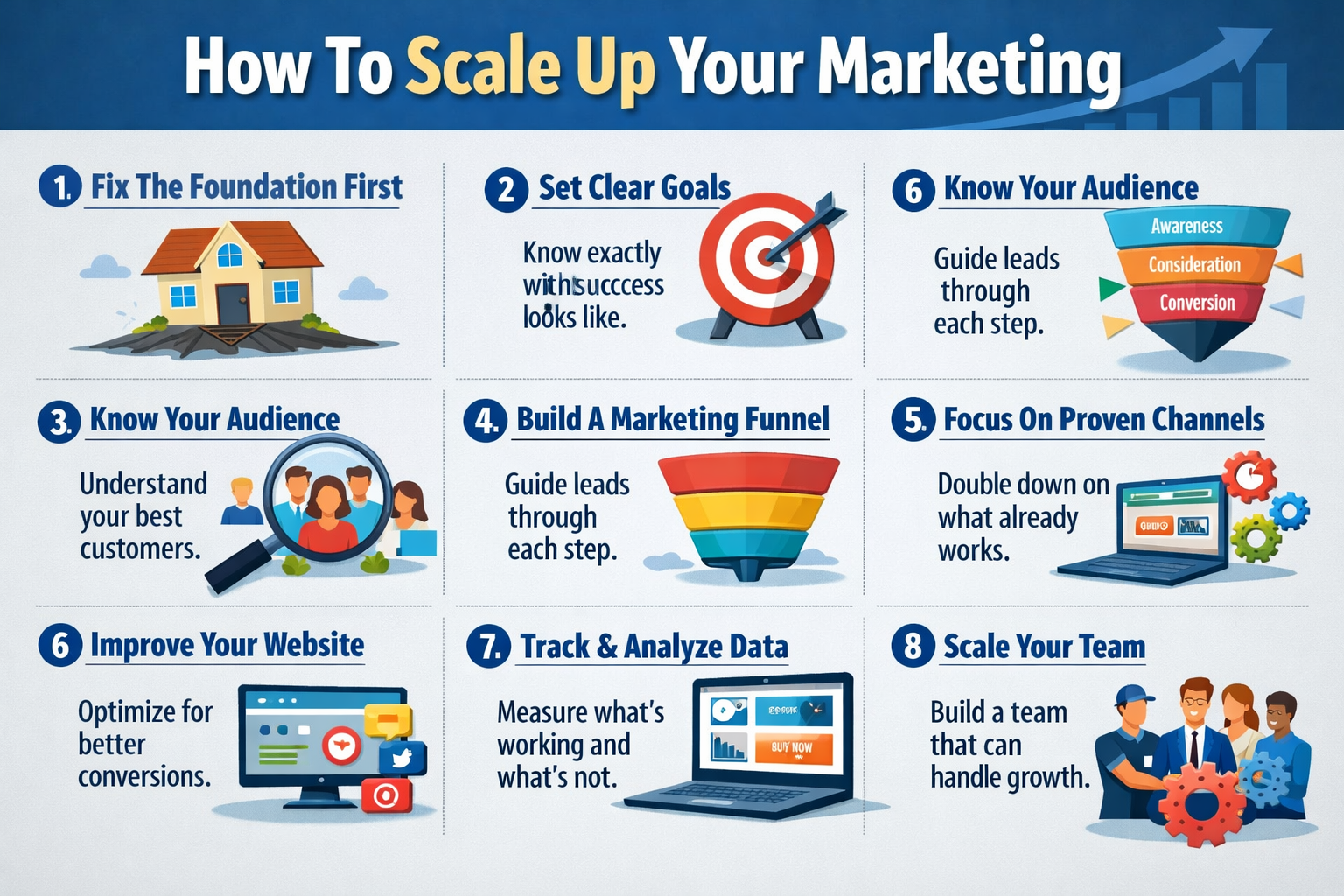
When people say they want to “scale up marketing,” they usually mean one thing: “I want more leads, more customers, and more revenue – faster.” But here’s the catch. Scaling isn’t just doing more of everything. It’s doing more of what works, in a smarter, more sustainable way.
Think of your marketing like a machine. At a small scale, you can push it manually. You post on social media yourself, you write your own emails, you manage your own ads. But when you want to grow, that “manual push” stops working.
So, how do you actually scale up marketing without burning out your team or wasting your budget? Let’s walk through it step by step, in plain language, with real-world logic.
Understand The Foundation Before You Scale
Before you pour fuel on the fire, you need to make sure there’s an actual fire. Scaling a broken or weak marketing setup just means you’ll waste more money, faster.
Ask yourself a few honest questions:
-
Do you know who your ideal customer really is?
-
Do you know which channels currently bring your best leads or sales?
-
Do you have a clear offer that people understand quickly?
-
Do you have any tracking in place to see what’s working?
If your answer is “not really” to most of these, scaling should wait. First, fix the foundation.
Scaling is like building a second floor. If the ground floor is shaky, the whole house becomes risky.
Clarify Your Goals: What Are You Actually Scaling?
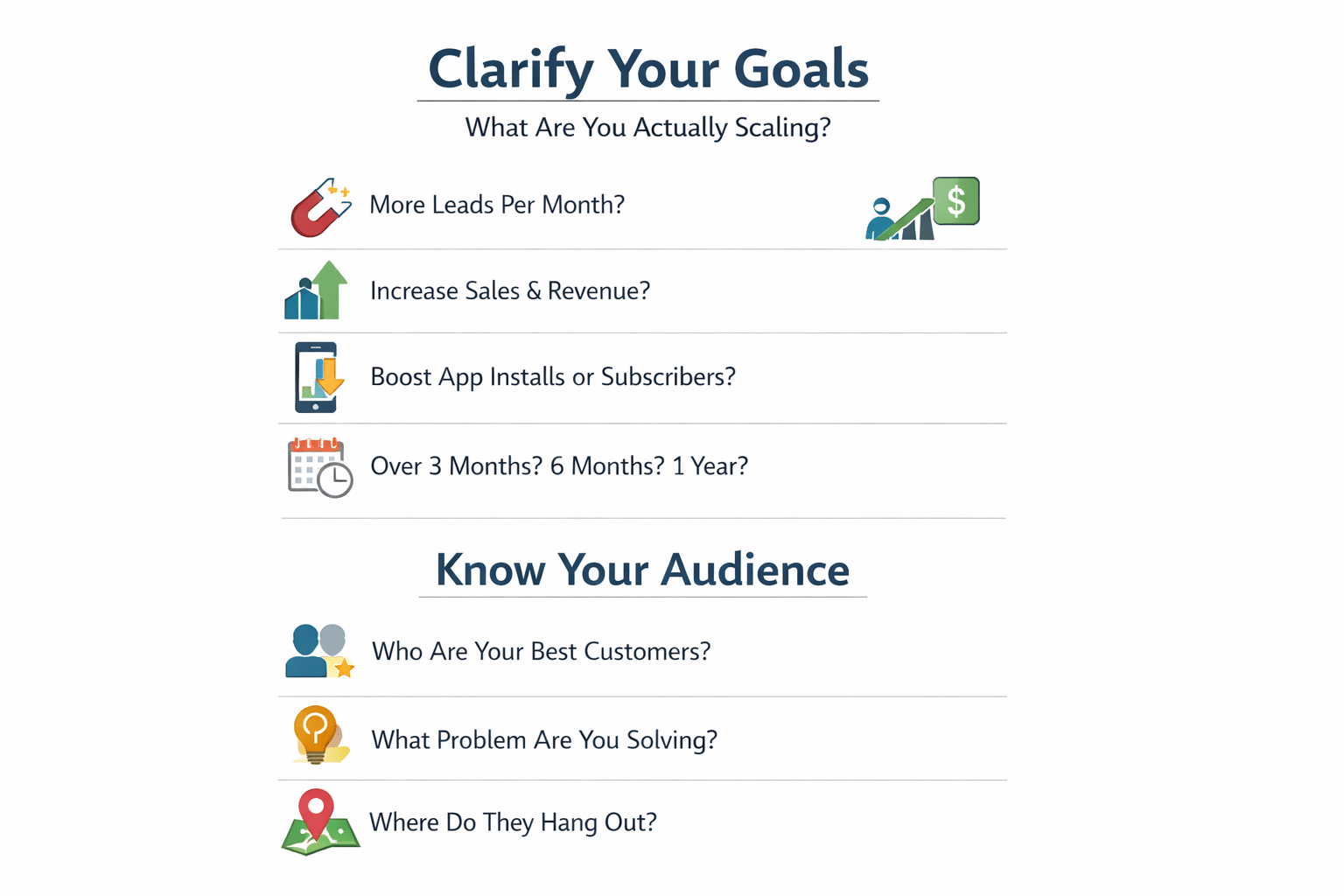
It sounds obvious, but many brands try to scale “marketing” without defining what success looks like. That’s like saying, “I want to go somewhere” without choosing a destination.
You need concrete goals:
-
Do you want more leads per month? How many?
-
Do you want more sales? At what average order value?
-
Do you want more app installs, demo bookings, store visits, or subscribers?
-
Over what time frame – 3 months, 6 months, 1 year?
Know Your Audience Deeply Before You Scale Up
You can’t scale effectively if you’re not clear about who you’re talking to. When you try to appeal to everyone, you end up resonating with no one.
You should know:
-
Who are your best customers (the ones who buy more, stay longer, or refer others)?
-
What problem are they really trying to solve with your product or service?
-
Where do they hang out online and offline?
-
What pushes them to finally say “yes” and buy?
Build A Scalable Marketing Funnel (Not Just Random Campaigns)
A lot of businesses think scaling up marketing means “run more ads” or “post more content.” That’s not scaling; that’s just activity.
What you really need is a simple, repeatable funnel:
-
People discover you (awareness).
-
They show interest or curiosity (engagement).
-
They consider you seriously (evaluation).
-
They buy (conversion).
-
They come back and buy again, or refer others (retention).
To scale, each of these stages needs at least one strong, repeatable system. For example:
-
Awareness: Paid social ads, SEO, content marketing, PR.
-
Engagement: Lead magnets, webinars, valuable social content.
-
Evaluation: Case studies, testimonials, product demos, free trials.
-
Conversion: Optimized landing pages, strong offers, retargeting ads.
-
Retention: Email sequences, loyalty programs, community, remarketing.
If your funnel is full of holes – for example, you get traffic but nobody converts – scaling ad spend just means you pay more for people to drop out earlier.
Double Down On What Already Works Before Exploring New Channels
Here’s one of the most overlooked truths about scaling up marketing: the fastest growth usually comes from optimizing and expanding channels that are already working.
Look at:
-
Which traffic sources currently bring your highest-quality leads or customers.
-
Which campaigns historically gave you the best return on ad spend.
-
Which content types or messages consistently perform well.
Then:
-
Increase the budget gradually where returns are good.
-
Clone high-performing campaigns and test variants (new creatives, new audiences, new devices).
-
Turn your best-performing content into multiple formats (blog → video → email → social posts).
For example, if Google Ads are already bringing in profitable leads, it’s usually smarter to scale from 500 to 2,000 clicks per month before you rush into a completely new platform just because it’s trendy.
Scaling isn’t always about something new. Often, it’s about doing more of what’s already quietly working.
Essential Channels To Consider When Scaling Up Marketing
Different businesses will scale with different channels, but there are some core marketing media that almost every growing brand should look at.
Paid Advertising: The Fastest Way To Turn Up The Volume
Paid ads are usually the first thing people think of when they hear “scale.” Why? Because they’re the most direct way to turn money into reach and, if done right, into revenue.
Main paid media options:
-
Search ads (Google, Bing): Capture people with high intent who are already searching for solutions.
-
Social ads (Meta, Instagram, LinkedIn, TikTok, X): Put your offer in front of specific audiences based on interests, behavior, or job titles.
-
Display and video ads: YouTube, programmatic banners, in-stream ads.
-
Marketplace ads: Amazon, Flipkart, etc., if you’re in ecommerce.
To scale with paid ads:
-
Start with small, controlled tests.
-
Track cost per lead and cost per purchase.
-
Kill weak campaigns quickly and reinvest into winners.
-
Use retargeting to stay in front of people who visited your site but didn’t buy.
Paid ads are like a volume knob. But if your song (offer + funnel) is bad, turning up the volume only annoys more people.
Content Marketing And SEO: The Long-Term Growth Engine
You don’t want to rely forever on paid ads only. At some point, costs rise, competition increases, and your margins get squeezed. That’s where content and SEO come in.
Scaling content marketing means:
-
Creating high-quality, search-optimized articles, guides, and resources around the questions your audience asks.
-
Building pillar content (in-depth, comprehensive pieces) and supporting content that links to them.
-
Repurposing content across formats – text, video, audio, visuals.
-
Publishing consistently, not randomly.
Why it matters for scaling:
-
SEO brings compounding traffic over time.
-
Good content builds authority and trust, which boosts all your paid campaigns.
-
You can support every stage of the funnel with the right content – awareness, evaluation, decision.
It’s slower to build, but once it’s working, it acts like a marketing asset that keeps delivering without extra ad spend for every single click.
Email Marketing And Automation: Scale Up Relationships, Not Just Clicks
Scaling up marketing is not just about finding more new people; it’s also about getting more value from the people you already have. Email is still one of the best tools for that.
To scale email marketing:
-
Build your list: use lead magnets, newsletter signups, discounts, or free resources.
-
Segment your audience: by behavior, interests, purchase history, or funnel stage.
-
Set up automated flows: welcome series, cart abandonment, post-purchase follow-ups, re-engagement campaigns.
-
Send regular, value-driven broadcasts: tips, news, offers, behind-the-scenes.
Automation is where scaling really kicks in. You can send personalized messages to thousands of people without writing each email manually. Your emails become a 24/7 salesperson, quietly doing their job while you work on other things.
Social Media: From Random Posting To Systematic Scaling
Most brands start with social media in a pretty chaotic way: posting when they remember, copying trends, and hoping something “goes viral.” That doesn’t scale.
Scaling social media means:
-
Choosing 1–2 core platforms where your audience is most active.
-
Defining clear content pillars: for example, education, inspiration, behind-the-scenes, customer stories.
-
Using a content calendar so you post consistently, not randomly.
-
Using ads to boost your best-performing posts instead of boosting everything.
-
Collaborating with influencers or creators once you have clear messaging.
Don’t try to dominate every platform at once. It’s better to be strong on two platforms than invisible on six.
Improve Your Website And Landing Pages Before You Scale Traffic
Here’s a harsh truth: many businesses don’t have a marketing problem; they have a website problem.
If your landing pages are confusing, slow, or weak, scaling traffic just means more people drop off without converting.
Key areas to improve:
-
Clear messaging: Above the fold, can people understand what you do and why it matters in 5 seconds?
-
Strong call to action: What’s the next step – book a demo, sign up, buy now, request a quote? Make it obvious.
-
Simple forms: Don’t ask for 15 fields if you only need 5.
-
Page speed and mobile experience: Slow and clunky pages kill conversions.
-
Social proof: Reviews, testimonials, case studies, trusted logos.
Even small improvements in conversion rate can completely change how far your budget can scale. Turning a 1% conversion rate into 2% means you doubled your sales without increasing traffic.
Data, Tracking, And Analytics: You Can’t Scale What You Can’t Measure
Scaling without data is like driving faster with your eyes closed. You might survive for a while, but it won’t end well.
Minimum tracking you should have:
-
Analytics on your website (Google Analytics or similar).
-
Conversion tracking for leads, purchases, and key events.
-
UTM parameters on your campaigns so you know which medium and message brought the traffic.
-
Dashboard or reports to see key numbers regularly: cost per lead, cost per acquisition, ROAS, conversion rate.
When you scale, you want to:
-
Identify your top-performing campaigns and audiences.
-
Spot waste quickly (channels or ads that don’t convert).
-
See how different mediums work together (search + social + email, for example).
Data doesn’t have to be complicated, but it must be present. Otherwise, “scaling” is just guessing.
Build A Team And Processes That Can Handle Scale
You can’t scale up marketing on sheer hustle forever. At some point, you need people and processes, not just effort.
Options:
-
In-house hires: marketers, content writers, performance marketers, designers.
-
Agencies: specialize in ads, SEO, content, creative, or PR.
-
Freelancers: flexible support for design, copywriting, video, etc.
-
Hybrid: a lean in-house team plus external partners.
What really matters is process:
-
Who owns which channel?
-
How do ideas move from concept to execution?
-
How often do you review performance and make decisions?
-
What tools do you use to manage tasks and track progress?
Think of scaling like running a newsroom. Stories (campaigns) come in, get reviewed, edited, scheduled, published, and then analyzed. Without workflow, you get chaos.
Smart Budgeting: How Much Should You Spend To Scale Up Marketing?
There’s no magic number, but you need a clear budget strategy. You can’t scale if you’re terrified to spend, but you also can’t just dump money without guardrails.
A simple approach:
-
Decide what percentage of revenue you’re comfortable reinvesting into marketing.
-
Allocate a base budget to proven channels.
-
Reserve a smaller percentage (say 10–20%) for experiments on new platforms, creatives, or offers.
-
Set clear thresholds: if a campaign doesn’t hit certain metrics, you cut or fix it.
Try not to think of marketing as a pure cost. At scale, marketing is more like buying money at a discount. If you spend X and consistently get 3X back, your real problem becomes “how fast and safely can I increase X?”
Common Mistakes When Trying To Scale Up Marketing
A lot of brands fail at scaling not because their product is bad, but because they fall into predictable traps.
Some of the big ones:
-
Scaling too early: pouring money into ads before product-market fit or before the funnel works.
-
Chasing every new platform: spreading resources too thin across too many channels.
-
Copying competitors blindly: what works for them might not work for you. You don’t see their internal numbers.
-
Ignoring retention: focusing only on new customers while existing ones quietly leave.
-
Not aligning marketing with sales and product: scaling marketing without improving onboarding, support, or product experience.
Scaling isn’t just “more marketing.” It’s aligning the whole business to handle more demand, more customers, and more visibility.
Case-Style Scenarios: How Different Businesses Scale Up Marketing
Let’s make this concrete with a few simplified scenarios.
-
Growing Ecommerce Brand
-
Current situation: Organic social and some basic Meta ads are working; email is underused.
-
Scale-up move:
-
Optimize and scale winning ad sets on Meta and maybe add Google Shopping.
-
Improve product pages and checkout.
-
Launch email automation: welcome flow, abandoned cart, post-purchase recommendations.
-
Introduce a loyalty program and referrals.
-
-
Result: More traffic + higher conversion + higher repeat purchase = real scale.
-
-
B2B SaaS Startup
-
Current situation: A few customers from referrals, basic website, little structured marketing.
-
Scale-up move:
-
Define ICP (ideal customer profile) and key use cases.
-
Create targeted landing pages and case studies.
-
Run LinkedIn and search ads for core keywords, send traffic to demos.
-
Host webinars and build an email nurture sequence.
-
-
Result: Repeatable pipeline from cold traffic to booked demos.
-
-
Local Service Business (e.g., clinic or coaching center)
-
Current situation: Mostly word-of-mouth and walk-ins.
-
Scale-up move:
-
Optimize Google Business Profile and local SEO.
-
Run local search and location-based ads.
-
Use WhatsApp and SMS for reminders, promotions, and follow-ups.
-
Collect reviews and display them on the website and profiles.
-
-
Result: Higher local visibility, more booked appointments, and more trust.
-
These examples show the same principle: scaling up marketing is about building systems, not random one-off actions.
Conclusion
When you strip away the jargon, scaling up marketing comes down to a few simple truths:
-
You need a solid foundation: clear offer, defined audience, basic tracking.
-
You double down on what already works before chasing shiny new tactics.
-
You build a funnel and systems that can handle more traffic and leads.
-
You use data to guide where to spend, where to cut, and where to innovate.
-
You treat marketing as an investment engine, not just an expense.
If you see scaling as a process, not a magic switch, it becomes less scary and more predictable.


