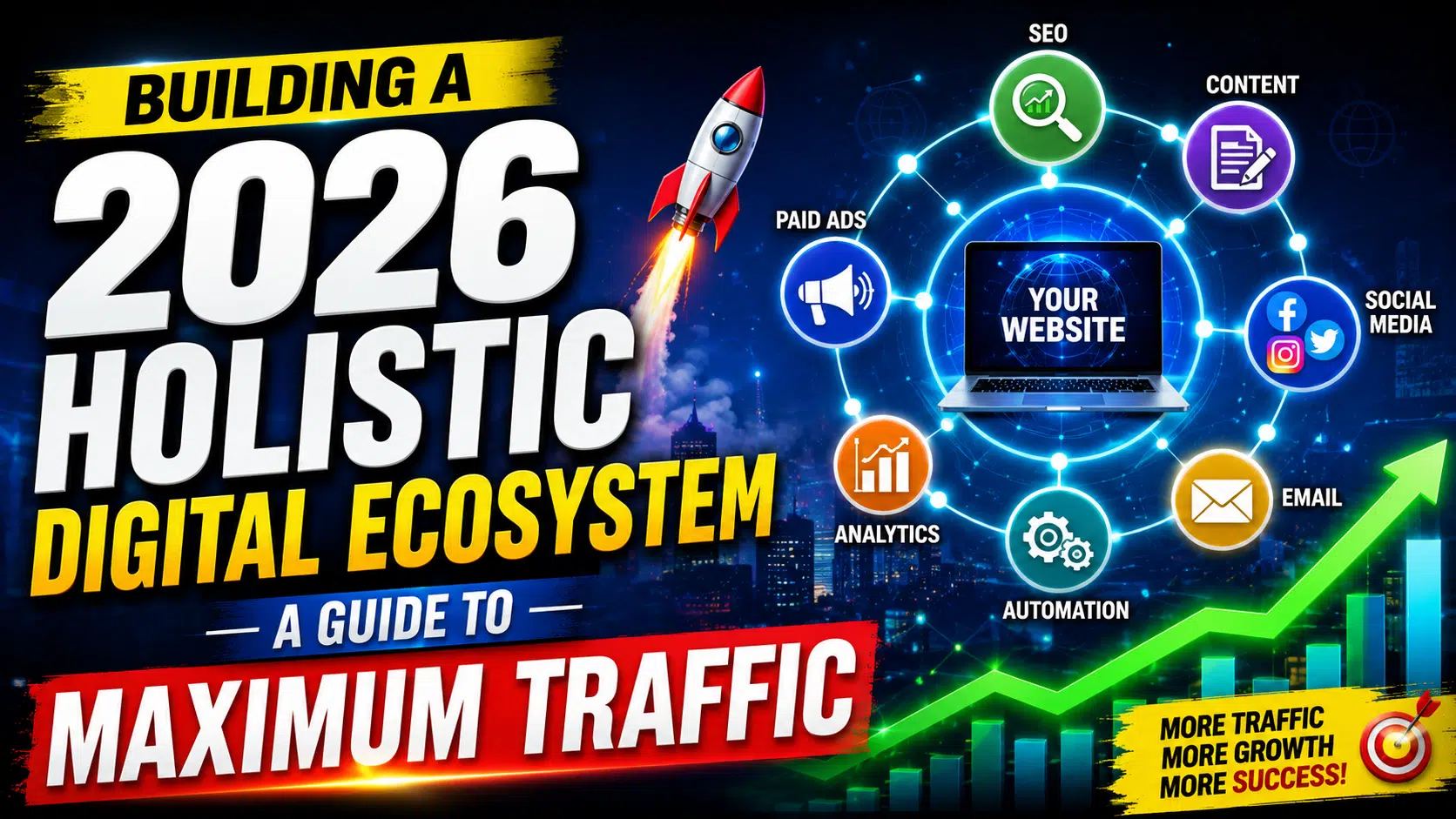
In the rapidly shifting digital environment of 2026, the concept of a “website” has evolved. It is no longer a destination but a node within a wider holistic digital ecosystem. To stay ahead of the curve and capture significant market share, businesses must look beyond simple traffic metrics and focus on the technical and creative integration of their entire online presence. A high-performing site today is one that seamlessly blends artificial intelligence, extreme performance, and deep psychological triggers to create a journey that feels effortless to the user.
FEATURED: The Rise of the AI-Enhanced Content Hub
As we look at the featured trends of the year, the most significant shift is the transition from static blogs to the AI-Enhanced Content hub. In 2026, content is no longer a one-way broadcast; it is an interactive dialogue. Modern websites are utilizing “Generative Interfaces” that adapt the complexity of the information based on the user’s reading level and intent.
If a visitor is looking for a quick summary, the AI provides a bulleted list; if they are looking for a deep dive, the system expands into a 3,000-word whitepaper. This adaptive approach is the cornerstone of a holistic digital ecosystem, ensuring that your site remains the primary source of truth for both human readers and search engine crawlers. By providing exactly what the user needs in real-time,
you increase engagement signals that search engines use to reward high-quality domains.
General Tips: Mastering Voice Search SEO and Predictive Engagement
Success in the modern era requires a departure from traditional “Click-Through” strategies. Our general tips for 2026 center on Voice Search SEO. With the ubiquity of AI assistants, more than 60% of searches are now conversational. Your content must be optimized to answer “Who, What, Where, and How” in a natural, spoken tone.
Furthermore, to maintain high traffic, you must implement Hyper-Personalized UX. This involves using first-party data to greet returning users with content they actually care about. Predictive engagement tools can now identify when a user is about to leave your site and offer a personalized “Lead Magnet” or a discount code tailored specifically to their browsing history. In 2026, the “average” user doesn’t exist; every visitor is a segment of one, and your strategy must reflect that level of granular attention.
Web Hosting: The Era of Cloud-Native Architecture
The infrastructure of 2026 is defined by the Cloud-Native Architecture. For a website to be truly resilient and fast, it must move away from legacy server models. Cloud-native hosting allows your site to exist in a “Containerized” environment, meaning it can move between global data centers instantly to avoid regional outages or latency spikes.
This leads to what we call the Zero-Latency Web. In an era where a 200ms delay can result in a 10% drop in conversions, your hosting must be capable of delivering assets at the speed of the user’s connection. Furthermore, modern hosting is now “Energy-Aware.” Search engines are beginning to display “Carbon-Efficient” badges in search results, making sustainable hosting a direct driver of traffic and brand trust. If your hosting isn’t green and globally distributed, you are losing visibility to competitors who prioritize technical sustainability.
Web Security & SEO: Biometric Web Security and Core Web Vitals 2026
Security has moved to the front lines of the user experience. A holistic digital ecosystem now incorporates Biometric Web Security for user logins,
replacing antiquated passwords with face or fingerprint recognition via the browser. This not only protects user data but also drastically reduces friction in the checkout or sign-up process.
On the SEO side, the metrics have evolved. Core Web Vitals 2026 now include “Responsiveness to AI Agents.” Search engines are measuring how easily their AI models can extract and verify the facts on your page. If your site is technically “messy,” you will be demoted in favor of sites with clean, structured data. Security is no longer just about preventing hacks; it’s about providing a “Verified Environment” that search engines feel safe recommending to their users. A secure site is a visible site,
and in 2026, trust is the highest-ranking factor.
Website Design: Visual Search Optimization and Sustainable UI
The visual landscape of the web has been transformed by Visual Search Optimization. Users are increasingly using their cameras to find products and information. Modern Website Design must include “Visual Anchors”—clear, high-quality images with embedded metadata that allow AI visual search tools (like Google Lens) to identify your content instantly.
We are also seeing the rise of Sustainable UI. This design philosophy focuses on reducing the energy consumption of the user’s device by using “Dark Mode” by default and minimizing heavy JavaScript execution. This is not just an environmental choice; it is a performance choice. A sustainable design is a lightweight design, and a lightweight design is a fast design. In the holistic digital ecosystem, every pixel must serve a purpose. If an element doesn’t contribute to the user’s goal, it is removed to ensure the fastest possible path to conversion.
WordPress: Scalable WordPress Systems and API-First Development
WordPress continues to dominate, but the way we build has changed. In 2026, we focus on Scalable WordPress Systems that utilize “Object-Oriented Programming” to handle massive datasets without slowing down. The platform has become the ultimate hub for API-First Development.
This means your WordPress site is no longer just a frontend; it is a content engine that feeds your mobile app, your social media channels, and even your “Internet of Things” (IoT) devices. By using WordPress as a “Decoupled” source of truth, you ensure that your brand voice is consistent across all digital touchpoints. The focus for 2026 is on “Interoperability”—ensuring your WordPress site talks seamlessly to your AI tools, your CRM,
and your global hosting network. When your platform is this integrated, traffic growth happens organically as your reach expands beyond the browser.
Conclusion: The Future is Integrated
The journey toward a holistic digital ecosystem is a journey toward total digital integration. By following this line-by-line 2026 strategy,
you are building a presence that is more than the sum of its parts.
When your Cloud-Native Architecture powers a Zero-Latency Web experience, and your AI-Enhanced Content is protected by Biometric Web Security,
you create an environment where traffic doesn’t just arrive—it stays and converts. The web of 2026 belongs to the efficient, the secure, and the intelligent. Use these insights to audit your current presence and pivot toward a more integrated, human-centric,
and technically superior future. Your website is the heart of your brand; ensure it beats with the rhythm of the modern digital world.